

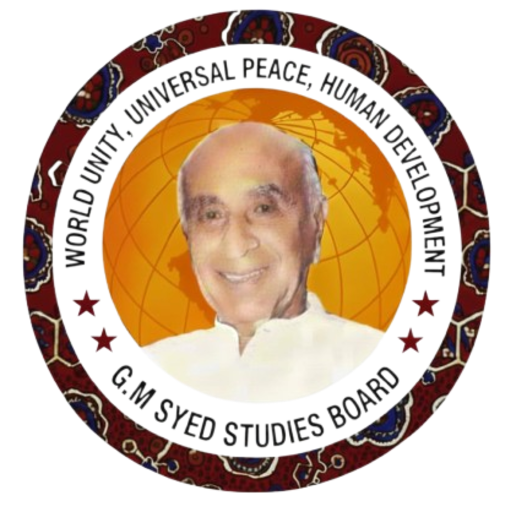
Political Journey
Early Life and Political Awakening
· Born: 17 January 1904 in Sann, Sindh (then Bombay Presidency, British India) into a prominent Sufi family — he was the Sajjada-nashin (hereditary spiritual custodian) of his family shrine.
· Grew up without formal schooling, but self-educated in Sindhi, English, Arabic, and Persian.
· His early exposure to Sufism and Sindhi cultural heritage helped shape his later political philosophy centered on peace, pluralism, and cultural identity.
· Political Engagement Begins: At age 16 (1920) he organized a Khilafat Conference in his hometown — his first major political action.
Rise in Provincial Politics (1920s–1930s)
- In the 1920s and 30s, Syed became deeply involved in Sindhi public affairs; he worked on education boards, local governance, and agrarian reform.
- Advocated for peasants’ rights, helped found cooperatives, and worked to protect Sindhi landholders.
- Separation of Sindh: One of his earliest major achievements was playing a leading role in securing Sindh’s separation from the Bombay Presidency in 1936, a landmark step in re-establishing political identity for Sindh.
Pre-Partition Nationalism and Pakistan Politics (1937–1954)
- Elected to the Sindh Legislative Assembly in 1937, and served as Minister of Education (1940–1941).
- Was one of the first Sindhi leaders to support the Two-Nation Theory and the idea of Pakistan, believing a Muslim-majority homeland would protect Sindh’s rights.
- In 1943, he moved the Pakistan Resolution in the Sindh Assembly; this was the only provincial assembly resolution passed in support of Pakistan under British rule.
- However, post-1947, he became disillusioned: Syed argued that the political establishment betrayed Sindh’s autonomy, cultural rights, and equitable control of resources.
Emergence as a Sindhi Nationalist (1950s–1960s)
- Opposition to Centralization: He opposed the One Unit Policy (1955) — a controversial plan that merged all of West Pakistan into one province — seeing it as political colonization of Sindh.
- In 1954, he chaired the Sindhi Adabi Board, promoting Sindhi culture and literature.
- Founded the Pakistan National Party, aligning with figures who opposed centralization and authoritarianism.
Cultural Revival and Intellectual Politics (1960s)
- In 1966, Syed established Bazm-e-Soofia-e-Sindh to revive Sindhi Sufi traditions and promote cultural consciousness.
- Sindh United Front (1969): This organization expanded his base, blending cultural pride with political mobilization and advocating separation of religion and state.
Birth of Sindhu Desh and the Jeay Sindh Movement (1972–1990)
This is the most defining phase of his political life — his transition from a provincial leader to the father of modern Sindhi nationalism.
Sindhu Desh Ideology
- After the 1971 Bangladesh independence, Syed concluded that Pakistan’s state structure could not accommodate regional autonomy; he argued that Sindh’s unique language, history, and civilization warranted self-determination.
- He articulated the concept of “Sindhu Desh” — a sovereign homeland for Sindhis based on secularism, cultural unity, human dignity, peace, and tolerance rooted in Sindh’s ancient Sufi tradition.
- His critique was two-pronged:
- Against religious-based nationalism (he saw the Two-Nation Theory as a failure to safeguard regional identity).
- Against centralized, Punjab-dominated state control that marginalized Sindh politically and economically.
Jeay Sindh Movement
- 1972: Syed founded the Jeay Sindh Mahaz (JSM), which became the organizational backbone of the Sindhudesh movement.
- The movement’s goals included:
- Political sovereignty for Sindh.
- Protection of Sindhi language and culture.
- Economic justice and control of provincial resources.
- Nonviolent political resistance toward state centralization.
State Repression and Imprisonment (1970s–1995)
- Syed’s radical stance brought him into direct conflict with successive Pakistani governments.
- He spent over 30 years in jail or under house arrest — often without trial — including his longest continuous detention from 1984 until his death in 1995.
- In 1994, Amnesty International recognized him as a Prisoner of Conscience for his peaceful struggle.
- Syed died on 25 April 1995 in hospital, still under house arrest.
Political Thought & Core Beliefs
Sindhu Desh Philosophy
Syed’s ideological foundation for Sindhu Desh combined:
- Cultural Nationalism: Sindh’s identity predates Islam — rooted in the ancient Indus Valley Civilization.
- Secular Humanism: He believed religion should remain personal and not define state politics.
- Sufi-Inspirited Unity: Drawing on Sindh’s Sufi traditions, he argued for tolerance, coexistence, and peace.
- Critique of Religious Nationalism: He later rejected the Pakistan model based on religious unity, seeing it as incompatible with pluralistic Sindh.
- Economic Justice: Syed criticized resource exploitation and the marginalization of Sindhi people within Pakistan’s political economy.
Legacy
- G. M. Syed is widely regarded as the architect of modern Sindhi nationalism and the intellectual father of Sindhu Desh.
- His writings (about 65 books) continue to influence Sindhi cultural and political thought.
- Although Sindhu Desh hasn’t become a realised nation-state yet, but the movement persists in various forms, and his ideas still shape political debates on autonomy, identity, and federalism in Sindh.