

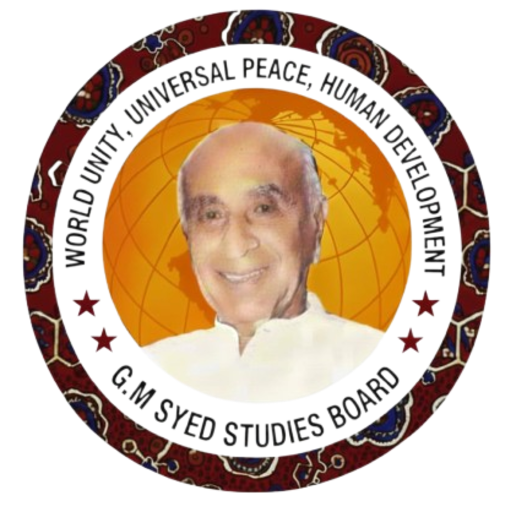
Chronological Biography
G. M. Syed, Syed Ghulam Murtaza Shah born on 17 January 1904 in Sann District Karachi, now Jamshoro District, belonged to a distinguished Sufi family tracing its lineage to Syed Haider Shah Sanai. Orphaned at an early age, he assumed the role of Sajjada-nashin of his family shrine while still a child, inheriting both spiritual responsibility and community leadership.
Despite lacking formal schooling, G. M. Syed pursued an extensive program of self-education. He mastered Sindhi, English, Arabic, and Persian, and developed deep knowledge of history, comparative religion, philosophy, and political theory. His intellectual formation was deeply influenced by Sindh’s ancient civilization, Sufi traditions, and global humanistic thought.
From a young age, he showed an exceptional interest in public affairs. By 1919, he had become Chairman of the local School Board, reflecting his early commitment to education and social development. His formative years coincided with major political transformations in British India, which shaped his early political consciousness.
Throughout his life, G. M. Syed remained personally simple, morally uncompromising, and intellectually disciplined. He was widely respected for his integrity and is regarded as one of the few major political figures in Pakistan’s history never accused of corruption.
He spent more than three decades of his life in prisons, detention centers, or under house arrest, mostly without trial. His final years were marked by extreme state repression. On 19 January 1992, his residence in Karachi was declared a sub-jail. In 1994, Amnesty International recognized him as a Prisoner of Conscience.
G. M. Syed passed away on 25 April 1995, still under state custody, ending a life defined by intellectual resistance, moral courage, and unwavering commitment to Sindh.
Chronological Biography of G. M. Syed (1904–1995)
Early Life & Background (1904–1919)
17 January 1904 Ghulam Murtaza Syed ( G.M Syed) was born in Sann village, then part of Karachi District (later Dadu / Jamshoro), Sindh, British India. He belonged to a prominent Sindhi Sadat family. His father was Syed Mohammed Shah Kazmi.
1 November 1905 His father passed away due to a family feud when G. M. Syed was about 16 months old.
1906–1915 As the only male heir, he was kept under protection by family elders. He began formal primary education in Sindhi at the age of six and completed it by 1915. Afterward, he received home education in Persian and English. During this period, he became largely self-educated in history, philosophy, and political thought.
Early Political Activism (1920–1936)
17 March 1920 At the age of 16, G. M. Syed organized his first political event, a Khilafat Conference in Sann, supporting pan-Islamic causes and opposing British colonial rule.
1919–1929 He began participating in local administration and leadership roles at a young age. Several accounts record his involvement in local and tehsil boards during his late teens and twenties.
1930 He organized the Sindh Hari Conference, advocating peasant rights, and served as its secretary, marking his growing role in mass politics.
Political Career Growth & British-Era Repression (1937–1946)
1937 Elected as a Member of the Sindh Legislative Assembly, emerging as a leading Sindhi political figure.
1938 Joined the All-India Muslim League, aligning with the movement for a Muslim homeland.
19 November 1939 – 9 January 1940 First Arrest Arrested by the British colonial government for political activism. Duration: 1 month 21 days
18 March 1940 – 7 March 1941 Served as Minister of Education of Sindh, becoming one of the province’s earliest senior Muslim League administrators.
1943 Elected President of the Sindh Muslim League. Under his leadership, the Sindh Assembly passed one of the earliest provincial resolutions supporting the creation of Pakistan.
1946 Due to disagreements with Muslim League leadership and political direction, he left the party and later formed the Progressive Muslim League, emphasizing workers’ and peasants’ rights.
Pakistan’s Creation & Early Post-Partition Repression (1947–1953)
17 August 1947 Pakistan was created. Although G. M. Syed had supported the Pakistan Movement, he soon became critical of post-partition centralization and the erosion of Sindh’s autonomy.
18 June 1948 – 18 August 1948 Second Arrest Arrested for ideological opposition to state policies. Often regarded as Pakistan’s first political prisoner. Duration: 2 months
3 November 1953 – May 1955 Third Arrest Detained for opposing centralized governance and advocating provincial rights. Duration: ≈ 1 year 6 months
Sindhi Autonomy to Nationalism (1954–1965)
1954 Founded the Sindh Awami Mahaz and helped establish political platforms advocating provincial autonomy and opposing authoritarian centralization.
Military Rule & Long-Term Detentions (1958–1969)
10 October 1958 – March 1966 Fourth Arrest Arrested after General Ayub Khan’s coup and placed under prolonged detention and house arrest. Duration: ≈ 7 years 5 months
23 June 1967 – 12 January 1969 Fifth Arrest Detained for continued nationalist political activity and criticism of military rule. Duration: ≈ 1 year 6 months
From Autonomy to Sindhudesh (1970–1973)
18 May 1971 – January 1972 Sixth Arrest Detained during the political crisis leading to the breakup of Pakistan. Duration: ≈ 1 year 8 months
August 1972 – January 1973 Seventh Arrest (Overlapping Period) Again detained during intensified repression in Sindh. Duration: ≈ 6 months (This period overlaps with the sixth arrest and is counted only once in total calculations.)
1966–Early 1970s Founded the Jeay Sindh Mahaz (JSM), formally articulating Sindhi nationalism, linguistic rights, and the concept of an independent Sindhudesh.
Criminalization of Sindhi Nationalism (1973–1987)
6 May 1973 – 2 July 1987 Eighth Arrest (Longest Detention) Arrested for writing and promoting Sindhudesh ideology. Placed under prolonged preventive detention and house arrest across multiple regimes. Duration: ≈ 17 years 2 months
1978 Under General Zia-ul-Haq, Sindhi nationalism was formally criminalized. • Nationalist literature banned • His residence in Sann placed under strict surveillance • Movement restricted • Declared a “separatist” and “threat to national integrity”
1979–1986 Despite isolation, he continued writing, dictating essays, mentoring youth, and guiding nationalist cadres. His residence became known as a “political university.”
1981 Criticized the Movement for the Restoration of Democracy (MRD), arguing democracy without national freedom was meaningless.
1983 During MRD uprisings in Sindh, mass repression occurred. Syed sympathized with victims but warned Sindh was being used as a battleground.
Late-Life Repression & Final Detentions (1987–1995)
12 December 1987 – 21 August 1988 Ninth Arrest Placed under renewed detention during ethnic and political unrest in Sindh. Duration: ≈ 8 months
10 October 1989 – 20 September 1990 Tenth Arrest Detained for condemning military operations, extrajudicial killings, and collective punishment in Sindh. Duration: ≈ 11 months
21 January 1992 – 25 April 1995 Eleventh Arrest (Final House Arrest) Placed under near-total isolation during Operation Clean-Up. Duration: ≈ 3 years 3 months (till death)
Death & Legacy (1995)
25 April 1995 G. M. Syed passed away in Karachi while still under house arrest, at the age of 91. • The state attempted to restrict public mourning • His funeral became a mass political gathering across Sindh • Buried in Sann, Sindh
His death marked the end of an era—but not the end of his ideology, which continues to shape Sindhi political thought.
G. M. Syed was one of the longest-detained political prisoners in the world. He was arrested or kept under house arrest 11 times between 1939 and 1995. Altogether, he spent approximately 31 years and 8 months in arrest and detention.
G. M. Syed – Arrest & House Arrest Detention History
|
|
|
|
Total Arrest / Detention Duration
Overlapping period (1939–1995)
Total 11 Times
Total Period 31 years and 8 months